Parkinson treatment in North York
Parkinson’s Disease Rehabilitation at One Step Ahead Mobility
Parkinson’s disease is a progressive neurological disorder that interferes with the brain’s ability to produce dopamine, the chemical messenger that enables smooth, coordinated movement. Classic motor symptoms—tremor, muscular rigidity, slowness of movement, and postural instability—can be accompanied by freezing of gait, speech and cognitive changes, and profound fatigue. Over time, these challenges may erode independence and quality of life.
Why Physiotherapy Is Essential
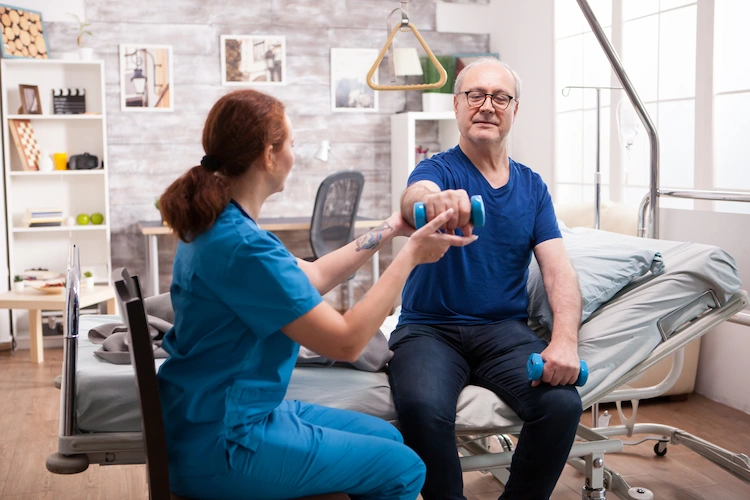
Clinical guidelines from both the European Physiotherapy Guideline for Parkinson’s Disease and the Canadian Guideline for Parkinson Disease view physiotherapy as a first-line intervention at every stage of Parkinson’s. Randomised controlled trials show that structured, therapist-supervised exercise can increase gait velocity by nearly 30 %, cut fall rates almost in half, and improve daily-living skills and quality-of-life scores more effectively than self-directed exercise.
Our Evidence-Based Approach
At One Step Ahead Mobility, treatment begins with a comprehensive assessment of motor control, balance, endurance, and cognitive function. From there, we design a personalised plan that may draw on the following methods:
LSVT BIG®
LSVT BIG® is an intensive four-week programme of large-amplitude, whole-body movements that recalibrates hypometric motor patterns, restoring stride length, arm swing, and trunk rotation.
PWR! Moves™
This programme builds on those amplitude principles and incorporates rhythm-driven tasks that improve posture, weight-shift, and transitional movements such as rising from a chair or getting down to the floor. Cognitively demanding elements help reduce freezing episodes and sharpen attention.
Posture & Spine Coaching
Focused visits teach safer ways to bend, lift and transfer from floor to standing. Spinal-extension work on our flexion-distraction table offloads vertebrae, and tailored core exercises reinforce an upright posture you can maintain at home or work.
Nordic Or Pole-Walking
This programme encourages reciprocal arm swing and greater propulsion. Clinical studies report an 18 % increase in Six-Minute Walk distance and fewer freezing episodes after pole-walking programmes.
Task-Specific Gait Retraining
Delivered on the treadmill or over ground, this exercise uses visual and auditory cues to address shuffling, festination, and freezing of gait.
Neuroplasticity-Driven Movement Training
Amplitude-based strengthening, balance perturbation, and agility drills are progressed at intensities that stimulate the neuroplastic change shown to underlie long-term improvements in movement quality.
Individualised Care Delivers Superior Results
Personal goals guide every decision: a gardener may want to kneel and rise with ease, while a grandparent aims to keep pace on family walks. Careful dosing ensures each session is challenging enough to drive neural adaptation yet safe enough to avoid over-fatigue or injury. Real-time feedback corrects unsafe movement patterns, while objective tracking of gait speed, balance scores, and Unified Parkinson’s Disease Rating Scale (UPDRS) measures keeps motivation high and progress visible.
Your Rehabilitation Journey
From the first appointment, our neuro-rehabilitation team partners with you to map out clear, achievable milestones. Sessions may include one-to-one physiotherapy, small-group pole-walking classes, or balance-lab workouts. Home programmes reinforce clinic gains, supported by education on pacing, medication timing, and strategies for managing fatigue. The ultimate goal is to help you move bigger, walk safer, and live with greater confidence—one step at a time.
Key Evidence At a Glance
Research on LSVT BIG® showed a 29 % increase in gait velocity compared with 6 % in control groups (Farley & Koshland, 2005). A 2021 meta-analysis of more than 1 200 participants found physiotherapy cut fall rates by 47 % (Shen et al., 2021). Amplitude-based movement training has demonstrated significant improvements in balance and cortical activation, underscoring the power of targeted, high-intensity practice to modify brain function (Mak et al., 2017).
References
Farley, B. G., & Koshland, G. F. (2005). Training BIG to move faster: The application of the speed–amplitude relation as a rehabilitation strategy for people with Parkinson’s disease. Journal of Neurologic Physical Therapy, 29(4), 177–188.
Grimes, D., et al. (2019). Canadian guideline for Parkinson disease. Canadian Journal of Neurological Sciences, 46(4), 476–482.
Huang, H., et al. (2022). Supervised physical therapy versus unsupervised home exercise on gait speed in Parkinson’s disease: A meta-analysis. Gait & Posture, 94, 38–45.
Keus, S. H. J., et al. (2014). European Physiotherapy Guideline for Parkinson’s Disease. Royal Dutch Society for Physical Therapy.
Mak, M. K., Hui-Chan, C. W. Y., & Canning, C. G. (2017). A randomised controlled trial of amplitude-based movement training for Parkinson’s disease. Clinical Rehabilitation, 31(3), 340–350.
Morgado, J. P., et al. (2020). Nordic walking as exercise intervention to improve mobility and quality of life in Parkinson disease: A randomised controlled trial. Clinical Rehabilitation, 34(1), 24–33.
Shen, X., Wong-Yu, I. S., & Mak, M. K. Y. (2021). Effects of exercise on falls, balance and gait in Parkinson’s disease: A meta-analysis of randomised controlled trials. Journal of the American Medical Directors Association, 22(3), 741–749.
Our Services
Neurological Physiotherapy
Orthopedic Physiotherapy
Geriatric Physiotherapy
Request an Appointment
Reserve your spot with our medical team in just minutes.